 BoreTherm
Heat pump model
The project's heat pump (Heat pump > Setup > Edit heat pump model): the coefficient of performance (COP) model, the heating curve and the operation. With temperature-dependent performance it converts the building loads in the borefield calculation and is the heat pump of the ground-source variant of the system comparison; the design point of the heat pump selection uses it in both modes. COP models: Datasheet interpolation (the COP between the EN 14511 test points, extrapolated with a constant share of the Carnot COP), Carnot efficiency (a constant share eta of the Carnot COP of the source and sink temperatures plus the heat exchanger lift; with one test point eta follows from it), Carnot_TCon of the Modelica Buildings library (the leaving temperatures with approaches that grow with the load, the evaporator outlet from the brine flow and a part-load efficiency curve) and Generic regression (a typical COP curve of the temperature lift for brine or air). The heating curve sets the flow and return temperature at the design outdoor temperature, the heating limit and the domestic hot water temperature; the minimum source temperature, the nominal power, variable speed, passive cooling and the cooling efficiency (EER) complete the operation. The preview checks the inputs with the core before OK; Edit as JSON edits every setting, also those the form does not show.
Step-by-step workflows · Menus and keyboard
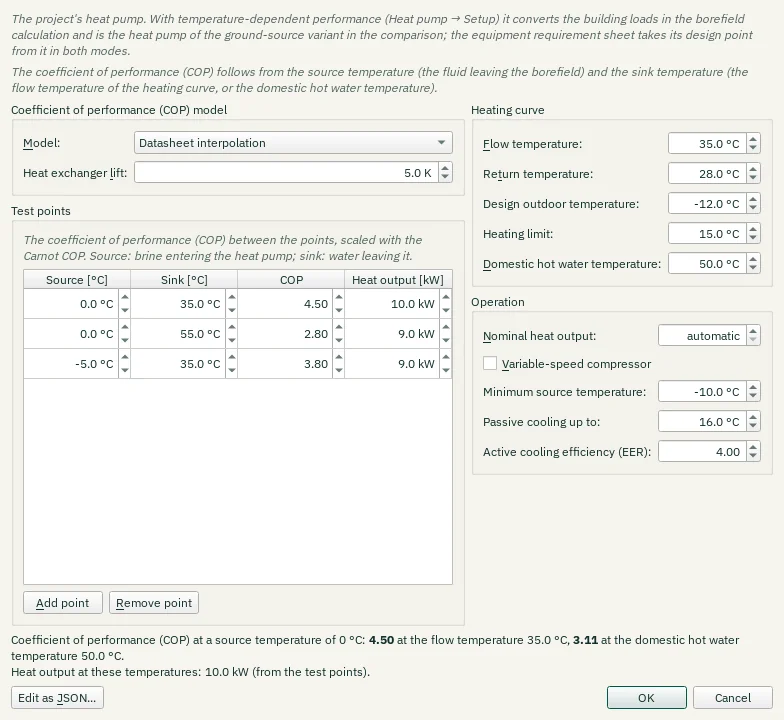
| Control | Meaning / action | Unit | Range / choices | Example value |
|---|---|---|---|---|
| Model: | Datasheet interpolation: the coefficient of performance (COP) between the test points, scaled with the Carnot COP.Carnot efficiency: a constant share η of the Carnot COP of the source and sink temperatures plus the heat exchanger lift.Carnot_TCon: the Carnot heat pump of the Modelica Buildings library (Buildings.Fluid.HeatPumps.Carnot_TCon): the leaving temperatures with approaches that grow with the load, the evaporator outlet from the brine flow, and a part-load efficiency.Generic regression: a typical COP curve of the temperature lift. | Datasheet interpolation / Carnot efficiency / Carnot_TCon (Modelica Buildings) / Generic regression | ||
| Source: | The curve of the generic regression: brine-to-water or air-to-water. | Ground (brine) / Air | ||
| Carnot efficiency η: | Carnot efficiency η: the coefficient of performance (COP) as a share of the Carnot COP. With exactly one test point, η follows from that point instead. | 0.01 to 1 | 0.45 | |
| Heat exchanger lift: | Added to the temperature lift for the Carnot coefficient of performance (COP): the temperature differences of the evaporator and the condenser. | K | 0 to 30 | 5 |
| Source temperature of the test point. | Source temperature of the test point. | °C | -40 to 60 | 0 |
| Sink temperature (condenser outlet) of the test point. | Sink temperature (condenser outlet) of the test point. | °C | -20 to 100 | 35 |
| Coefficient of performance (COP) measured at the test point. | Coefficient of performance (COP) measured at the test point. | 1.01 to 20 | 4.5 | |
| Heat output at the test point; 0 = not given. | Heat output at the test point; 0 = not given. | kW | 0 to 100000 | 10 |
| Add point | Add an evaluation point; configure its position and inspect the calculated value. | |||
| Remove point | Runs the named action. | |||
| Condenser approach: | Condenser approach at nominal load (TAppCon_nominal): the refrigerant condenses this much above the water leaving the condenser. It scales with the load. | K | 0 to 30 | 2 |
| Evaporator approach: | Evaporator approach at nominal load (TAppEva_nominal): the refrigerant evaporates this much below the brine leaving the evaporator. It scales with the evaporator heat. | K | 0 to 30 | 2 |
| Nominal condenser outlet: | Condenser leaving temperature of the nominal point (TCon_nominal). Not used with one test point: its temperatures are the nominal point. | °C | -20 to 100 | 35 |
| Nominal evaporator outlet: | Evaporator leaving temperature of the nominal point (TEva_nominal). Not used with one test point. | °C | -40 to 60 | -3 |
| Part-load coefficients: | Coefficients a₁; a₂; a₃; … of the part-load efficiency ηPL(y) = a₁ + a₂·y + a₃·y² + … (a), y = heat output / nominal heat output, separated by semicolons. They must add up to 1. 1 = no part-load effect. | |||
| Flow temperature: | Flow temperature at the design outdoor temperature. | °C | 15 to 90 | 35 |
| Return temperature: | Return temperature at the design outdoor temperature. The flow temperature falls linearly from the flow temperature to this value at the heating limit. | °C | 10 to 90 | 28 |
| Design outdoor temperature: | Design outdoor temperature. A comparison replaces it with that of its climate. | °C | -40 to 10 | -12 |
| Heating limit: | Outdoor temperature above which the building is not heated. | °C | 0 to 25 | 15 |
| Domestic hot water temperature: | Sink temperature while the heat pump heats domestic hot water. | °C | 30 to 80 | 50 |
| Nominal heat output: | Heat output of the heat pump. 0: from the heat output of the test points, or from the loads when the points give none. Carnot_TCon: also its nominal heat output. | kW | 0 to 100000 | 0 |
| Variable-speed compressor | On: the compressor follows the load (Carnot_TCon: part load y = load / nominal heat output). Off: an on/off machine runs at full output and cycles. Also used for the annual performance factor after VDI 4650. | |||
| Minimum source temperature: | Below this source temperature the heat pump stops and the backup heater takes over. | °C | -30 to 20 | -10 |
| Passive cooling up to: | Passive cooling while the fluid is at most this warm; above it, active cooling. | °C | 0 to 30 | 16 |
| Active cooling efficiency (EER): | Cooling efficiency (EER) of active cooling with the heat pump: cooling output divided by electrical input. | 1 to 20 | 4 | |
| OK | Accept changes and close. | |||
| Cancel | Close without accepting unapplied edits. | |||
| Edit as JSON… | All settings of the heat pump as text, also those this form does not show (VDI 4650 options, synthetic weather). | |||
| Heat exchanger lift: | Added to the temperature lift for the Carnot coefficient of performance (COP): the temperature differences of the evaporator and the condenser. | °F | 0 to 54 | 9 |
| Source temperature of the test point. | Source temperature of the test point. | °F | -40 to 140 | 26.6 |
| Sink temperature (condenser outlet) of the test point. | Sink temperature (condenser outlet) of the test point. | °F | -4 to 212 | 95 |
| Heat output at the test point; 0 = not given. | Heat output at the test point; 0 = not given. | MW | 0 to 100 | 0.01 |
| Condenser approach: | Condenser approach at nominal load (TAppCon_nominal): the refrigerant condenses this much above the water leaving the condenser. It scales with the load. | °F | 0 to 54 | 3.6 |
| Evaporator approach: | Evaporator approach at nominal load (TAppEva_nominal): the refrigerant evaporates this much below the brine leaving the evaporator. It scales with the evaporator heat. | °F | 0 to 54 | 3.6 |
| Nominal condenser outlet: | Condenser leaving temperature of the nominal point (TCon_nominal). Not used with one test point: its temperatures are the nominal point. | °F | -4 to 212 | 95 |
| Nominal evaporator outlet: | Evaporator leaving temperature of the nominal point (TEva_nominal). Not used with one test point. | °F | -40 to 140 | 26.6 |
| Flow temperature: | Flow temperature at the design outdoor temperature. | °F | 59 to 194 | 95 |
| Return temperature: | Return temperature at the design outdoor temperature. The flow temperature falls linearly from the flow temperature to this value at the heating limit. | °F | 50 to 194 | 82.4 |
| Design outdoor temperature: | Design outdoor temperature. A comparison replaces it with that of its climate. | °F | -40 to 50 | 10.4 |
| Heating limit: | Outdoor temperature above which the building is not heated. | °F | 32 to 77 | 59 |
| Domestic hot water temperature: | Sink temperature while the heat pump heats domestic hot water. | °F | 86 to 176 | 122 |
| Nominal heat output: | Heat output of the heat pump. 0: from the heat output of the test points, or from the loads when the points give none. Carnot_TCon: also its nominal heat output. | MW | 0 to 100 | 0 |
| Minimum source temperature: | Below this source temperature the heat pump stops and the backup heater takes over. | °F | -22 to 68 | 14 |
| Passive cooling up to: | Passive cooling while the fluid is at most this warm; above it, active cooling. | °F | 32 to 86 | 60.8 |