 BoreTherm
Equipment selection
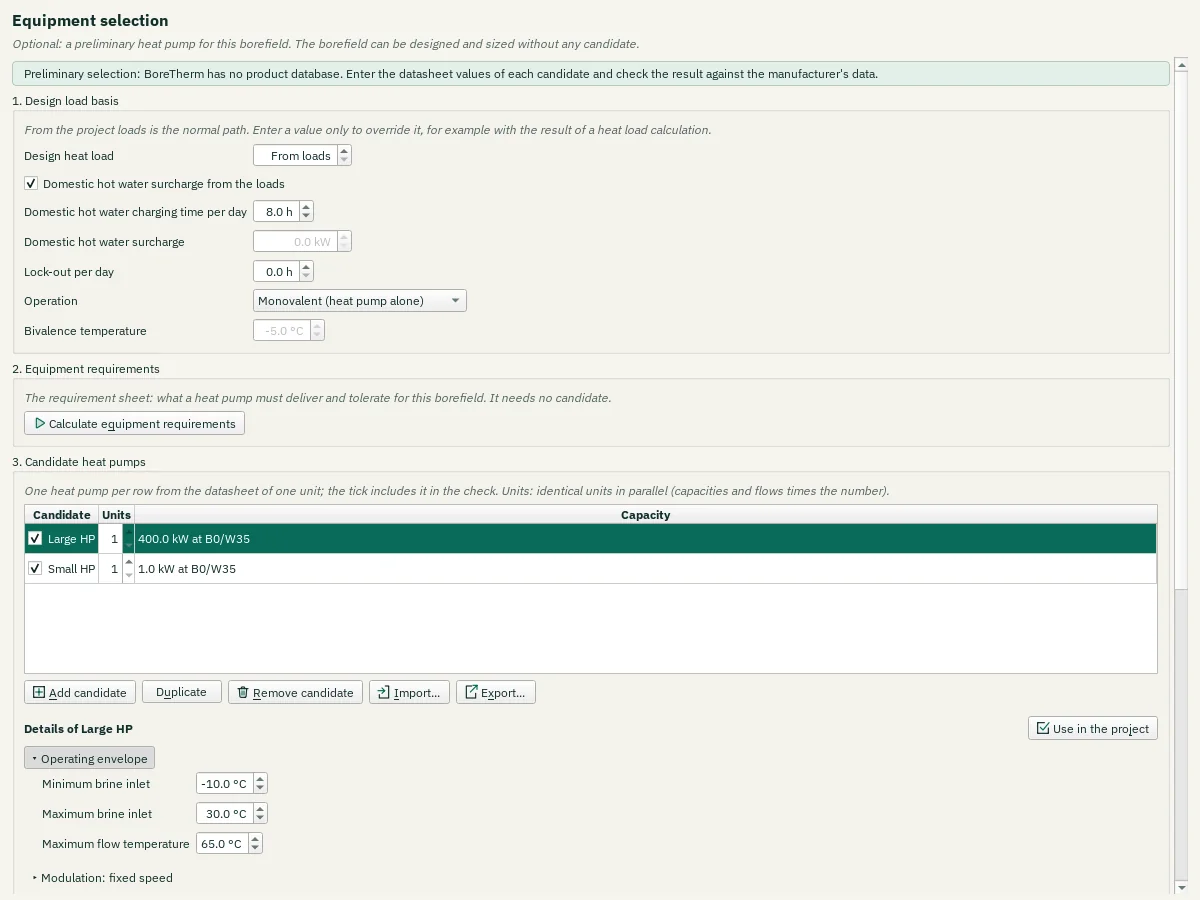
Optional: a preliminary check of brine/water heat pumps against this borehole field (BoreTherm has no product database); the borefield can be designed and sized without any candidate. The page follows the work. 1. Design load basis: from the project loads is the normal path; the design heat load (From loads = the largest heating peak of the loads), the domestic hot water surcharge from the loads (largest daily hot water energy / charging time) or entered, the utility lock-out hours per day (capacity x 24 / (24 - lock-out)), monovalent or mono-energetic operation with the bivalence temperature. 2. Calculate equipment requirements: the requirement sheet without any candidate (an incomplete candidate does not stop it). 3. Candidate heat pumps: a compact list (name, the tick that includes it in the check, the number of identical units in parallel and the capacity at B0/W35 times the units) and the details of the selected candidate in collapsible sections: operating envelope (minimum and maximum brine inlet, maximum flow temperature), modulation in % of the datasheet capacity (100 / 100 = fixed speed), hydraulics (residual head and nominal brine flow of an internal brine pump, the evaporator pressure drop at the nominal brine flow, scaled with the square of the flow), cooling (active cooling capacity, cooling efficiency (EER)) and the EN 14511 test points (brine inlet, water outlet, coefficient of performance (COP), heating capacity). A section header names missing values (Not provided) and marks problems also while it is collapsed. Add, duplicate and remove candidates; Import reads a candidate JSON file (one candidate, a list, or the heat pump selection of a project file), Export writes the selected one. Use in the project makes the selected candidate the project's heat pump model in the temperature-dependent mode (the capacity of all its units, its minimum brine inlet, its modulation and, when the heat pump also cools, its EER), after a question, as one undo step; every result is then out of date and the borehole length is not changed. The list marks the candidate that is the project's heat pump; after an edit of the candidate or of the model the mark goes and the candidate can be used again. 4. Check settings (collapsed): the source temperature margin, the pressure drop of the header and connection pipes and of the free-cooling heat exchanger (counted only when the project cools passively), the buffer rule of a fixed-speed machine, the Tight thresholds and the optional sizing per candidate, which adds calculation time. 5. Check candidates computes the selection (Heat pump > Selection results). Every edit is one undo step and marks only the heat pump selection out of date, not the design results. Heat pump setup opens Heat pump > Setup with the project's heat pump model and heating curve, which give the design point, and whether the heat pump also cools actively.
Step-by-step workflows · Menus and keyboard
| Control | Meaning / action | Unit | Range / choices | Example value |
|---|---|---|---|---|
| Design heat load | Design heat load of the building (heat load calculation). From loads: the largest heating peak of the loads. | kW | 0 to 100000 | 0 |
| Domestic hot water surcharge from the loads | The largest daily domestic hot water energy of the loads divided by the charging time; otherwise the surcharge entered below. | |||
| Domestic hot water charging time per day | Daily charging time of the domestic hot water store: surcharge = largest daily hot water energy / this. | h | 0.5 to 24 | 8 |
| Domestic hot water surcharge | Domestic hot water surcharge on the heating capacity. | kW | 0 to 100000 | 0 |
| Lock-out per day | Utility lock-out hours per day: the capacity is raised by 24 / (24 − lock-out). | h | 0 to 20 | 0 |
| Operation | Monovalent: the heat pump covers the load down to the design outdoor temperature. Mono-energetic: down to the bivalence temperature, a heating rod covers the rest. | Monovalent (heat pump alone) / Mono-energetic (with heating rod) | ||
| Bivalence temperature | Mono-energetic operation: below this outdoor temperature the heating rod helps. | °C | -40 to 30 | -5 |
| Calculate equipment requirements | Simulate the design and compute the requirement sheet without checking candidates (Heat pump → Selection results). | |||
| Number of identical units in parallel on one brine loop and one heating loop: capacity, power, brine flow and cooling capacity times the number; the smallest stage is one unit at its minimum modulation. | Number of identical units in parallel on one brine loop and one heating loop: capacity, power, brine flow and cooling capacity times the number; the smallest stage is one unit at its minimum modulation. | 1 to 20 | 1 | |
| Add candidate | Runs the named action. | |||
| Duplicate | Runs the named action. | |||
| Remove candidate | Runs the named action. | |||
| Import… | Add candidates from a JSON file: one candidate, a list of them, or the heat pump selection of a project file. | |||
| Export… | Save the selected candidate as a JSON file (the form of the project file). | |||
| Use in the project | Make this candidate the project's heat pump model (Heat pump → Setup), with the performance from the fluid temperature. The borehole length is not changed. | |||
| ▾ Operating envelope | Runs the named tool action. | |||
| Minimum brine inlet | Lowest brine inlet temperature of the operating envelope. | °C | -40 to 40 | -10 |
| Maximum brine inlet | Highest brine inlet temperature of the operating envelope. | °C | -20 to 60 | 30 |
| Maximum flow temperature | Highest water outlet (flow) temperature. | °C | 20 to 90 | 65 |
| ▸ Modulation: fixed speed | fixed speed | |||
| Lowest capacity | Lowest capacity in % of the datasheet capacity (100 = fixed speed). | % | 1 to 200 | 100 |
| Highest capacity | Highest capacity in % of the datasheet capacity. | % | 1 to 200 | 100 |
| ▸ Hydraulics: not provided: nominal brine flow, evaporator pressure drop | not provided: nominal brine flow, evaporator pressure drop | |||
| Residual head of an internal brine pump | Residual (external) head of the internal brine pump at its nominal flow. | kPa | 0 to 2000 | 0 |
| Nominal brine flow | Nominal brine flow of one unit. | l/s | 0 to 1000 | 0 |
| Evaporator pressure drop | Brine-side pressure drop of the evaporator of one unit at its nominal brine flow, scaled with the square of the flow. | kPa | 0 to 1000 | 0 |
| ▸ Cooling: no active cooling capacity | no active cooling capacity | |||
| Active cooling capacity | Active cooling capacity of one unit. | kW | 0 to 100000 | 0 |
| Cooling efficiency (EER) | Cooling efficiency (EER) of active cooling: cooling output divided by electrical input. | 0 to 30 | 0 | |
| ▾ Test points (EN 14511): 4 points | 4 points | |||
| Brine temperature entering the heat pump (EN 14511 "B"). | Brine temperature entering the heat pump (EN 14511 "B"). | °C | -40 to 60 | -5 |
| Water temperature leaving the heat pump (EN 14511 "W"). | Water temperature leaving the heat pump (EN 14511 "W"). | °C | -20 to 100 | 35 |
| Coefficient of performance (COP) at the test point. | Coefficient of performance (COP) at the test point. | 1.01 to 20 | 4 | |
| Heating capacity at the test point. | Heating capacity at the test point. | kW | 0 to 100000 | 400 |
| Add point | Add an evaluation point; configure its position and inspect the calculated value. | |||
| Remove point | Runs the named action. | |||
| ▸ 4. Check settings | Runs the named tool action. | |||
| Source temperature margin | The heat pump's minimum source temperature must be at most the simulated minimum mean fluid temperature minus this margin (and its maximum at least the simulated maximum plus it). | K | 0 to 20 | 2 |
| Header and connection pipes | Pressure drop of the header and the connection pipes, added to the field's pressure drop for the pump head. | kPa | 0 to 10000 | 0 |
| Free-cooling heat exchanger pressure drop | Brine-side pressure drop of the free-cooling heat exchanger at the field flow. Added to the pump head only when the project cools passively, in series with the evaporator. | kPa | 0 to 10000 | 0 |
| Maximum starts per hour | Compressor starts per hour allowed: the buffer rule limits the cycling of a fixed-speed heat pump to this. | 1/h | 0.5 to 20 | 3 |
| Switching differential | Switching differential of the buffer store. | K | 0.5 to 20 | 5 |
| Buffer volume | Installed buffer volume including the effective water content of the heating system. Not provided: the starts are estimated with the minimum buffer. | l | 0 to 1e+06 | 0 |
| Tight below a capacity margin of | A capacity, flow or head with a smaller relative margin is marked Tight. | % | 0 to 50 | 10 |
| Tight below a temperature margin of | A temperature limit with a smaller margin is marked Tight. | K | 0 to 10 | 1 |
| Also size the borehole length for every candidate | A coupled sizing per candidate (about five simulations per trial length). | |||
| Heat pump setup… | Heat pump → Setup: the project's heat pump model and heating curve, which give the design point and the evaporator capacity of the requirement sheet, and whether the heat pump also cools actively. | |||
| Check candidates | Simulate the design, compute the requirement sheet and check the ticked candidates (Heat pump → Selection results). | |||
| Use in the project | Select a candidate. | |||
| ▸ Modulation | Runs the named tool action. | |||
| ▸ Hydraulics | Runs the named tool action. | |||
| ▸ Cooling | Runs the named tool action. | |||
| ▾ Test points (EN 14511) | Runs the named tool action. | |||
| Design heat load | Design heat load of the building (heat load calculation). From loads: the largest heating peak of the loads. | MW | 0 to 100 | 0 |
| Domestic hot water surcharge | Domestic hot water surcharge on the heating capacity. | MW | 0 to 100 | 0 |
| Bivalence temperature | Mono-energetic operation: below this outdoor temperature the heating rod helps. | °F | -40 to 86 | 23 |
| Minimum brine inlet | Lowest brine inlet temperature of the operating envelope. | °F | -40 to 104 | -40 |
| Maximum brine inlet | Highest brine inlet temperature of the operating envelope. | °F | -4 to 140 | -4 |
| Maximum flow temperature | Highest water outlet (flow) temperature. | °F | 68 to 194 | 68 |
| Nominal brine flow | Nominal brine flow of one unit. | m³/h | 0 to 3600 | 0 |
| Active cooling capacity | Active cooling capacity of one unit. | MW | 0 to 100 | 0 |
| Source temperature margin | The heat pump's minimum source temperature must be at most the simulated minimum mean fluid temperature minus this margin (and its maximum at least the simulated maximum plus it). | °F | 0 to 36 | 3.6 |
| Switching differential | Switching differential of the buffer store. | °F | 0.9 to 36 | 9 |
| Tight below a temperature margin of | A temperature limit with a smaller margin is marked Tight. | °F | 0 to 18 | 1.8 |