 BoreTherm
Loads
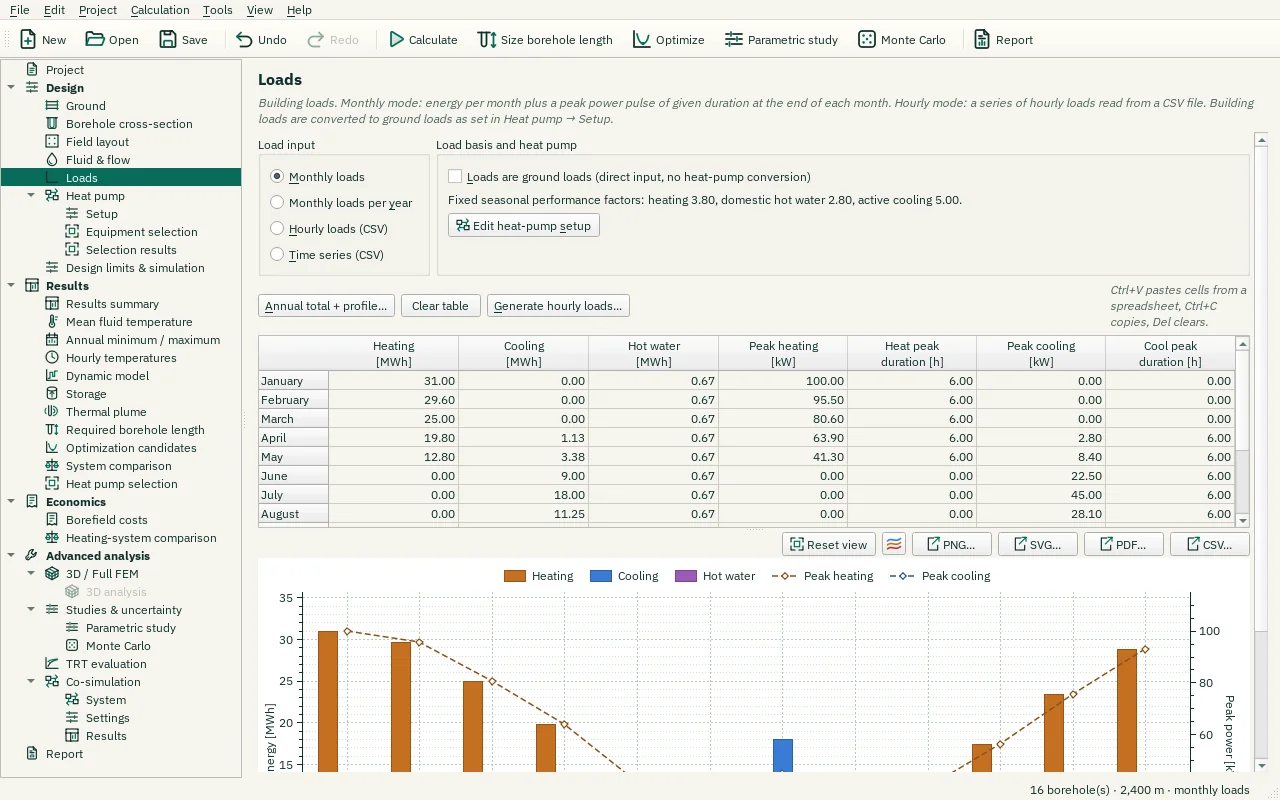
Monthly profiles include annual energies, monthly shares, peak powers and pulse durations. Building loads are converted to ground loads by the project's heat pump, set on Heat pump › Setup (fixed seasonal performance factors or a temperature-dependent model); use ground-load input when the conversion has already been done. Hourly and timestamped series can be imported or generated. Ground heat injection is positive and extraction negative in signed series. Inspect coverage, repeated schedules and peak/base consistency warnings before running.
Step-by-step workflows · Menus and keyboard
| Control | Meaning / action | Unit | Range / choices | Example value |
|---|---|---|---|---|
| Monthly loads | Monthly energy plus monthly peak loads. | |||
| Hourly loads (CSV) | Hourly load series (8760 values per year, up to 100 years) from a CSV file. | |||
| Time series (CSV) | Ground loads at any constant step (minutes to hours), optionally with the flow and the inlet temperature: measured data, a test record or a heat-pump model. Made for the dynamic borehole model; the other models use the hour means. | |||
| Monthly loads per year | Monthly energy and peak loads for every year of the calculation period, e.g. for a demand that grows or falls over the years. | |||
| Loads are ground loads (direct input, no heat-pump conversion) | Checked: heating = heat extracted from the ground, cooling = heat injected into the ground; no conversion with the heat pump settings. | |||
| Edit heat-pump setup | Heat pump → Setup: the performance mode, the seasonal performance factors, the cooling and the heat pump model. | |||
| Show: | Quantity shown and edited in the table: one row per year, one column per month. | Heating energy [MWh] / Cooling energy [MWh] / Domestic hot water energy [MWh] / Peak heating [kW] / Heat peak duration [h] / Peak cooling [kW] / Cool peak duration [h] | ||
| Years in the table: | Years in the table. Normally the calculation period; later years of the period use the last year of the table. | 1 to 100 | 1 | |
| Copy monthly table | Every year of the table gets the loads of the monthly table. | |||
| Growth / decline… | Fill the table from the monthly table with a change per year or a step change. | |||
| Import CSV… | Read the table: one row per year and month with the columns year, month, heating_MWh, cooling_MWh, dhw_MWh, peakHeating_kW, peakHeatingDuration_h, peakCooling_kW, peakCoolingDuration_h (header optional; trailing columns may be left out). | |||
| Export CSV… | Write the displayed numerical table to a CSV file using the selected CSV format. | |||
| Generate hourly loads… | Hourly loads for every year of the period from this table (energy per month kept, peaks reached), as the hourly load input. | |||
| Reset view | Show all data (also: double-click the plot). | |||
| Chart style button | Chart style: title, axis titles, legend, colours, line widths and markers, fonts, grid and background (also in the chart's context menu). | |||
| PNG… | Export the plot as a PNG image. | |||
| SVG… | Export the plot as a vector SVG image (for Word, Inkscape, …). | |||
| PDF… | Export the plot as a vector PDF. | |||
| CSV… | Export the plotted data as CSV. | |||
| Import time series… | Read ground loads at a constant step from a CSV file: time, load [, flow] [, inlet temperature], with a preview and the units of the file. | |||
| Generate BTES operation… | One year of seasonal operation of a thermal energy store (charge, rest, discharge by month) with the inlet temperature or the ground load, the flow and the flow direction. | |||
| Clear | Remove the currently loaded series from this input. | |||
| Import CSV… | Read hourly loads: one row per hour, columns heating[, cooling[, dhw]] in kW (header optional). 8760 rows (repeated every year) or 8760 × years. | |||
| Annual total + profile… | Distribute annual energy totals over the months with a monthly profile. | |||
| Clear table | Set all monthly values to zero. | |||
| Generate hourly loads… | Hourly loads from these monthly loads (energy per month kept, peaks reached), as the hourly load input. |