 BoreTherm
Ground layers and groundwater
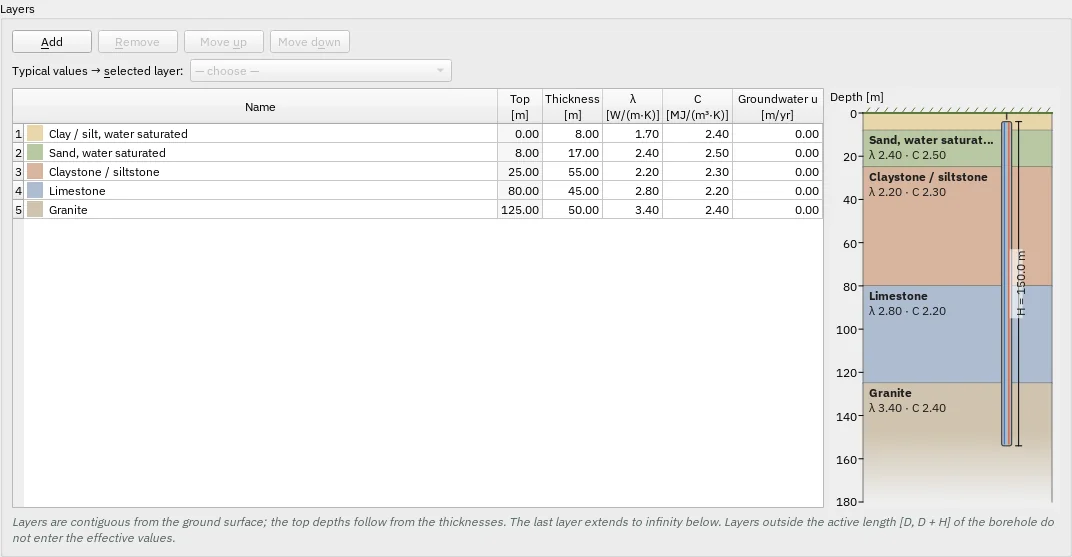
The ground layers (add, remove, reorder; typical values for the selected layer) and the groundwater: a uniform aquifer over the whole depth or per layer, with the Darcy velocity and the flow direction used by the moving line source.
Step-by-step workflows · Menus and keyboard
| Control | Meaning / action | Unit | Range / choices | Example value |
|---|---|---|---|---|
| Add | Insert a new layer below the selected one (λ and C from the homogeneous values). | |||
| Remove | Remove the selected evaluation item or interval from this table. | |||
| Move up | Move the selected layer earlier in the layer table; recalculate its depth placement. | |||
| Move down | Move the selected layer later in the layer table; recalculate its depth placement. | |||
| Typical values → selected layer: | Fill λ and C of the selected layer with typical values (VDI 4640); a layer with a generic name is renamed after the rock type. | — choose — / Clay / silt, dry (λ = 0.5, C = 1.6) / Clay / silt, water saturated (λ = 1.7, C = 2.4) / Sand, dry (λ = 0.4, C = 1.4) / Sand, water saturated (λ = 2.4, C = 2.5) / Gravel, water saturated (λ = 1.8, C = 2.4) / Claystone / siltstone (λ = 2.2, C = 2.3) / Sandstone (λ = 2.3, C = 2.2) / Limestone (λ = 2.8, C = 2.2) / Granite (λ = 3.4, C = 2.4) / Gneiss (λ = 2.9, C = 2.2) / Basalt (λ = 1.7, C = 2.6) / Quartzite (λ = 6.0, C = 2.1) | ||
| Uniform aquifer over the whole depth | Groundwater flows horizontally through the whole ground with one Darcy velocity. The heat it carries away is modelled with the moving finite line source (Molina-Giraldo et al. 2011). For an aquifer in some layers only, enter the velocities in the layer table instead. | |||
| Darcy velocity u: | Darcy velocity (specific discharge) u of the groundwater, in metres per year. 1 m/yr = 3.17·10⁻⁸ m/s. Typical: clay < 0.1, silt/fine sand 0.1 – 10, sand and gravel 10 – 1000 m/yr (from hydraulic conductivity × gradient). | m/yr | 0 to 10000 | 3.154 |
| Flow direction: | Direction the groundwater flows towards, in degrees from the +x axis of the field, counter-clockwise (0° = +x, 90° = +y). | ° | 0 to 359.9 | 0 |
| Water heat capacity: | Volumetric heat capacity (ρc)w of the groundwater; 4.18 MJ/(m³·K) for water at about 10 °C. | MJ/(m³·K) | 3 to 4.3 | 4.18 |