The fluid properties (conductivity , specific heat , density , dynamic viscosity and freezing point) are evaluated at one temperature, the fluid property temperature (the example uses 2 °C, near the winter mean fluid temperature). They are used for the Reynolds and Prandtl numbers, the convection coefficient, and the pressure drop.
6.1 Water
Pure water uses fits to the CRC Handbook (61st ed.), valid for 0 < T ≤ 100 °C, which agree with IAPWS/NIST within about 0.3 % over 0–60 °C:
| k | (density) | (specific heat) | (conductivity) |
|---|---|---|---|
| 0 | 999.83952 | 4.21534 | 0.560101 |
| 1 | 16.945176 | −2.87819·10⁻³ | 2.11703·10⁻³ |
| 2 | −7.9870401·10⁻³ | 7.4729·10⁻⁵ | −1.05172·10⁻⁵ |
| 3 | −4.6170461·10⁻⁵ | −7.79624·10⁻⁷ | 1.497323·10⁻⁸ |
| 4 | 1.0556302·10⁻⁷ | 3.220424·10⁻⁹ | −1.48553·10⁻¹¹ |
| 5 | −2.8054253·10⁻¹⁰ | – | – |
The viscosity uses two forms:
Equation (6.2) applies for T ≥ 20 °C and (6.3) below; T is in °C, in kg/m³, in J/(kg K), in W/(m K) and in Pa s.
6.2 Aqueous solutions: Melinder correlations
Monoethylene glycol (MEG), monopropylene glycol (MPG) and ethanol solutions use the correlations of Melinder (2010), with the coefficients of a published open-source implementation of them. Every property is a double polynomial in the mass fraction (in %) and the temperature (°C) around a centre point :
with one of , , , and (18 coefficients each). The freezing point depends on only and is evaluated at . The temperature must lie above the freezing point; otherwise, and outside the ranges of Table 12, BoreTherm stops with an error message.
| Fluid | [%] | [°C] | Mass fraction | Temperature |
|---|---|---|---|---|
| MEG / water | 30.8462 | 31.728 | 0–60 % | °C |
| MPG / water | 30.7031 | 32.7083 | 0–60 % | °C |
| Ethanol / water | 29.2361 | 8.1578 | 0–60 % | °C |
| Water | – | – | – | 0 < T ≤ 100 °C |
| Fluid | [°C] | [kg/m³] | [J/(kg K)] | [mPa s] |
|---|---|---|---|---|
| Water | 0.0 | 1000.0 | 4203 | 1.52 |
| MEG 25 % | −11.0 | 1035.8 | 3775 | 3.08 |
| MPG 25 % | −9.8 | 1024.5 | 3884 | 4.39 |
| Ethanol 20 % | −11.1 | 974.4 | 4360 | 4.06 |
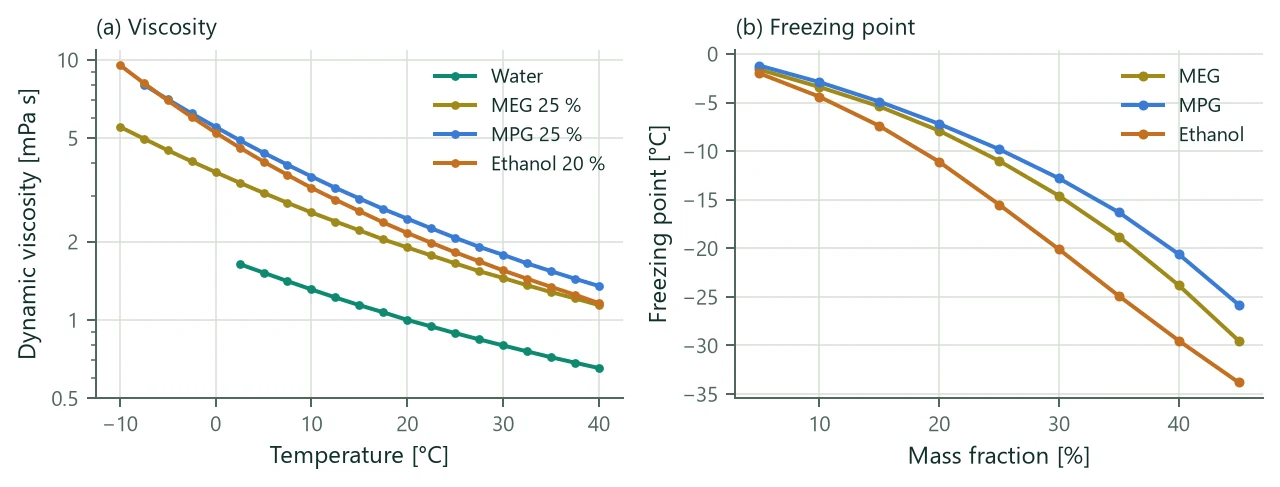
Figure 7a shows why antifreeze matters hydraulically: at 0 °C, 25 % MPG is about three times as viscous as water, which lowers Re by the same factor and can make the flow laminar. A Custom fluid with constant, user-given properties is also available; the verification computations use it to keep the property correlations out of comparisons.