BoreTherm does not ask for a lump-sum price of the borefield. It measures the design (metres drilled, boreholes, circuits, trench, grout, fluid) and multiplies each quantity by a unit price. The estimate is a list of lines, quantity × unit price, and every total follows from the lines. Two cost models price the same quantities: a simple model with five prices and a detailed model with an itemised price list. Both give the same kind of result (lines, group totals, net, contingency, net total, VAT, gross), and the sizing, the layout optimizer, the heating-system comparison and the report all use it. Nothing of the thermal model is recalculated, so the estimate follows every change of the design at once; it never feeds back into the simulation.
The example is a small office or school building (about 3000 m²) with monthly loads of 200 MWh/a heating, 8 MWh/a hot water and 45 MWh/a cooling, on a 4 × 4 field of 16 single-U boreholes of 150 m at 6 m spacing with 4 m buried depth and 25 % monopropylene glycol, simulated over 25 years.
28.1 Quantities from the design
With boreholes, of which are to be drilled (boreholes marked as existing are connected but not drilled), the drilled and the probe length of borehole with buried depth , active length , tilt from the vertical and a foot length drilled below the active part are
with a head allowance of 1 m. The other quantities:
- Drilled metres by drilling class: the vertical extent of each new borehole overlaps the ground layers; each overlap (divided by the cosine of the tilt) is priced with the drilling class of its layer, below the last layer with the last class. A homogeneous ground has one class.
- Deep boreholes: new boreholes with above 100 m. The depth surcharge applies to their whole drilled length, and any one of them triggers the German mining-law notification (§ 127 BBergG).
- Grout and cuttings: with the borehole diameter (that of a borehole section where one is defined), the pipe outer diameter and = 2, 4 or 6 legs (single, double, triple U; 1 for a coaxial exchanger, the outer pipe), an excess factor (1.2 by default) and a bulking factor (1.3):
- Circuits, manifolds, welds: the circuits are the parallel strings of the field network; manifolds (16 ports each by default); welds with welds per borehole by probe type (single U 2, double U 6, coaxial 2) and series links.
- Trench: the minimum spanning tree of the borehole heads and the manifold point, × (1 + detour), split into an unpaved and a paved share. The manifold is at the user's point, else at the site's connection point, else at the head nearest the centroid of the field.
- Connection pipes (tree routing, the default): for each circuit the supply to its first and the return from its last borehole along the trench tree, the series links, and two risers of 1 m per circuit and per link, × (1 + detour). Radial routing uses straight distances; a fixed length per circuit is the third option. Pipe metres and trench metres are priced separately: the trench once, the pipes per circuit.
- Fluid: the volume of probes, connection pipes and header pair, plus 2 l per manifold port and a plant allowance; the mass at the property temperature, and the antifreeze concentrate with the mass fraction .
Existing boreholes take no drilling, probe, grout or per-borehole cost, but they count for circuits, welds, connection pipes, trench and fluid. The quantity options (foot length, grout excess, detour, paved share, header length, building entries, number of thermal response tests) change the cost only; the thermal model does not see them.
28.2 Simple model
With the prices (fixed), (per new borehole), (per metre), (per circuit) and (per metre of trench), the trench length , the contingency and the VAT rate :
| Input | Unit | Default | Covers |
|---|---|---|---|
| Fixed cost | € | 5,000 | mobilisation, permits, design, manifold as one sum |
| Per borehole | €/borehole | 800 | set-up, tests, head, welds |
| Per metre | €/m | 80 | drilling incl. probe and grout (all-in; public guides give 50–120 €/m) |
| Length basis | – | drilled length | the length the price per metre applies to (or the active length) |
| Per circuit | €/circuit | 0 | manifold port, connection pipes, welds |
| Per metre of trench | €/m | 70 | trench incl. backfill |
| Contingency / VAT | % | 10 / 19 | on the net / on the net total; VAT never changes a ranking |
Projects from earlier versions keep their four optimizer prices with the active length, no price per circuit and 0 % contingency and VAT, which reproduces their earlier cost exactly. The simple model has no depth step and no geology.
28.3 Detailed model
Every item of a price list has a quantity basis (a derived quantity, a fixed quantity typed by the user, or a percentage of groups) and a unit price . With the regional factor and the index factor (escalation from the price date) the line total and the net are
and the totals follow (28.4). Percentage items (design and site supervision, 10 % of groups A–E) take their fraction of the non-percentage lines of their groups and are not multiplied by . The structure follows the bill of quantities of the German model specification for borehole heat exchanger installations (BWP 2012) and the cost groups of DIN 276. The built-in list holds indicative net prices for Germany from public sources, each with a range and a source; a price outside its range is marked, and users are expected to keep their own lists from tender results.
| Group | Main items (quantity basis) | Default net prices |
|---|---|---|
| A Site and preliminary works | mobilisation (lump sum), rig set-up per new borehole; UXO probing, utility survey (off) | 3,000 €; 250 €/pc |
| B Drilling | drilling per class (drilled m by class), depth surcharge (drilled m of deep boreholes); casing, cuttings disposal (off) | loose / mixed / hard 45 / 55 / 70 €/m; +8 €/m above 100 m |
| C Probes, grouting, tests | probe by type (probe m), installation, pressure and flow test (per new borehole), thermally enhanced grout (m³), thermal response test (count) | single / double / triple U, coaxial 5 / 10 / 14 / 25 €/m; 200 €; 150 €; 700 €/m³; 5,000 € |
| D Horizontal connection | trench unpaved / paved (m), connection pipes (m), welds (pc), manifold and ports, header pair (m), building entry, commissioning | 70 / 180 €/m; 10 €/m; 50 €; 1,000 € + 300 €/port; 60 €/m; 800 €; 1,500 € |
| E Heat-carrier fluid | antifreeze concentrate by fluid (kg); premix (off) | MEG 2.5 €/kg, MPG 6.0 €/kg |
| F Design, permits, ancillary | geological forecast and design, water-law permit, mining-law notice (one deep borehole), design and supervision (% of A–E), documentation | 1,500 €; 300 €; 1,000 €; 10 %; 500 € |
Hints accompany the estimate: the prices are the indicative defaults; a ground layer has no drilling class; no thermal response test is priced although the peak ground extraction exceeds 30 kW, above which VDI 4640 recommends one; the price date is more than two years old (set an index factor); the currency differs from the one the project used. The mining-law item applies only to German price lists.
Three indicators make estimates comparable: the net total per drilled metre, per metre of active length, and per kW of peak ground extraction.
28.4 Worked example
| Item | Quantity | Unit price [€] | Total [€] | |
|---|---|---|---|---|
| A | Mobilisation, site setup and clearance | 1 lump sum | 3,000 | 3,000 |
| A | Rig set-up per position | 16 pc | 250 | 4,000 |
| B | Drilling, Mixed / soft rock | 2,464 m | 55 | 135,520 |
| B | Surcharge for boreholes deeper than 100 m | 2,464 m | 8 | 19,712 |
| C | Probe supply, single U | 2,480 m | 5 | 12,400 |
| C | Probe installation incl. sinker weight | 16 pc | 200 | 3,200 |
| C | Grouting, thermally enhanced | 40.76 m³ | 700 | 28,532 |
| C | Pressure and flow test per probe | 16 pc | 150 | 2,400 |
| D | Trench, unpaved, incl. sand bed and backfill | 90 m | 70 | 6,300 |
| D | Connection pipes laid | 632 m | 10 | 6,320 |
| D | Welds | 64 pc | 50 | 3,200 |
| D | Manifold incl. chamber, valves, flow meters | 1 pc | 1,000 | 1,000 |
| D | Manifold port per circuit | 16 pc | 300 | 4,800 |
| D | System test, flushing, commissioning, balancing | 1 lump sum | 1,500 | 1,500 |
| E | Antifreeze concentrate | 829 kg | 6 | 4,973 |
| F | Geological forecast, field design, permit application | 1 lump sum | 1,500 | 1,500 |
| F | Water-law permit fee | 1 lump sum | 300 | 300 |
| F | Mining-law notification (borehole deeper than 100 m) | 1 lump sum | 1,000 | 1,000 |
| F | Design and site supervision | 236,857 € | 10 % | 23,686 |
| F | Documentation | 1 lump sum | 500 | 500 |
| Group | Net [€] | Share of the net total [%] |
|---|---|---|
| A Site and preliminary works | 7,000 | 2 |
| B Drilling | 155,232 | 53 |
| C Probes, grouting, tests | 46,532 | 16 |
| D Horizontal connection | 23,120 | 8 |
| E Heat-carrier fluid | 4,973 | 2 |
| F Design, permits, ancillary | 26,986 | 9 |
| Contingency 10 % | 26,384 | 9 |
| Net total | 290,227 | 100 |
| VAT 19 % → gross | 345,371 |
Drilling (group B) is more than half of the net total. All 16 boreholes are deeper than 100 m drilled, so the depth surcharge (19,712 €) and the mining-law notice apply. The indicators are 117.8 € per drilled metre, 120.9 € per active metre and 3,939 € per kW of peak ground extraction (73.7 kW). The simple model with the project's own four optimizer prices (5,000 € fixed, 800 € per borehole, 45 € per metre of active length, 60 € per metre of trench, no contingency) gives 131,200 €, 53.2 € per drilled metre. The two models differ here because their prices differ, not their method: check which prices stand for the market before comparing layouts or heating systems with them.
28.5 Cost against length and number of boreholes
Each line scales with one driver: per field (lump sums: mobilisation, commissioning, geology and permit, documentation, the mining-law notice), per new borehole (set-up, installation, pressure test), per drilled metre (drilling, depth surcharge, grout, probe), per circuit (manifold ports, welds, risers), per metre of trench and pipe (layout and spacing), per kg of fluid (pipe volume), and as a percentage of all of these (design and supervision, contingency). Most of the money follows the drilled metres, but a good part follows the number of boreholes, the circuits and the layout.
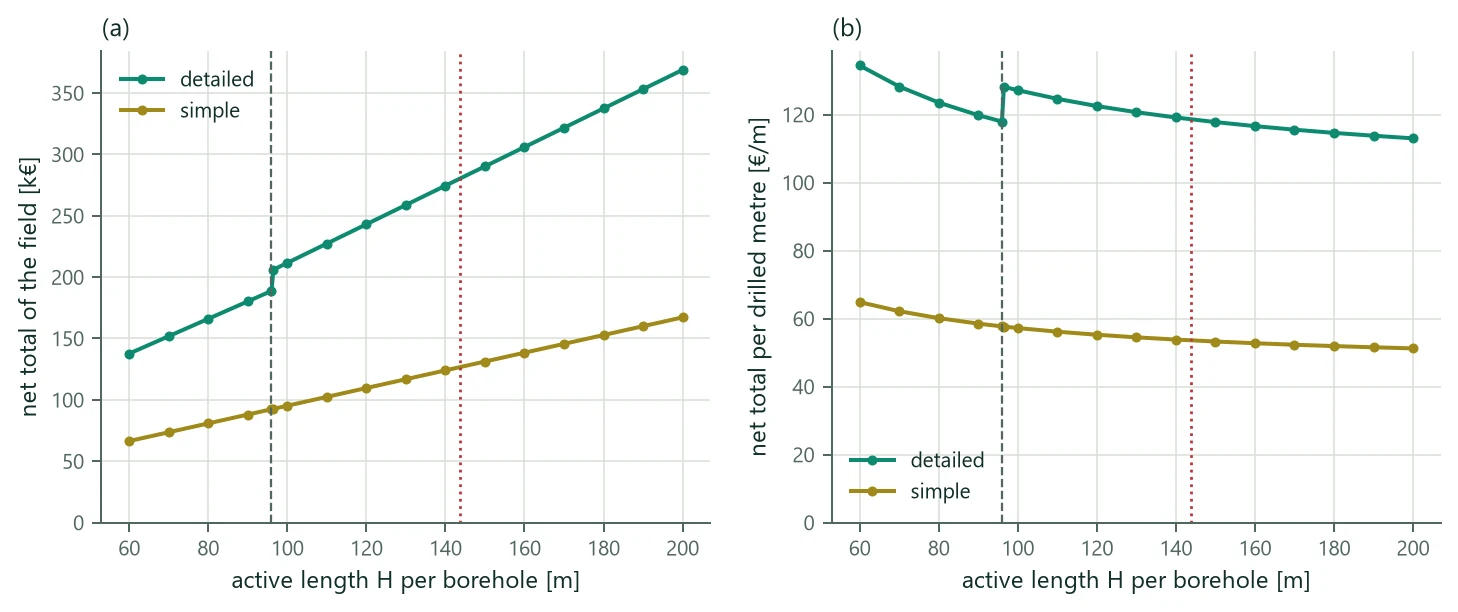
Figure 24 prices the example field at active lengths from 60 to 200 m. Two effects are not obvious. First, the cost per metre falls with the length, because the per-field and per-borehole items spread over more metres (detailed model: 134.4 €/m at 60 m, 113.0 €/m at 200 m). Second, the detailed list has a step at 100 m drilled length: a deeper borehole pays the depth surcharge on its whole length, and one deep borehole triggers the mining-law notice. In the example the net total rises by 17,374 € from H = 96 to 96.5 m, for 8 more drilled metres. Two boreholes of 98 m drilled length can therefore be cheaper than one of 196 m. The simple model has no such step.
28.6 Cost at the sized length and the cost-optimal layout
The thermal design decides the metres; the cost model only prices them. After Size borehole length the Costs page also shows the net total with the mean length scaled to the sized H, i.e. the cost of applying the sizing result. In the example the field needs 143.7 m instead of 150 m; the detailed net total becomes 280,347 € (118.6 €/m), 9,881 € less.
The layout optimizer (Optimize) enumerates layouts on the plot (layout type, rows, spacing), sizes each one and prices it at its own sized length with the project's cost settings; the objective *Total cost* ranks by the net total including contingency and excluding VAT (both are proportional and never change the order). Every candidate gets the default network (all boreholes in parallel, or strings of the boreholes in series set for the field flow) and the manifold at the site's connection point or the head nearest the centroid; explicit strings and existing boreholes of the project do not carry over to a new layout. Because the cost is a step function of the layout (the 100 m class, manifold sizes, lump sums), the optimizer compares candidates instead of searching with gradients. There is no continuous economic optimum over the depth: the candidates are thermally sized first and then priced.
| Rank | Simple prices: layout | Drilled [m] | Net total [€] | Detailed prices: layout | Net total [€] |
|---|---|---|---|---|---|
| 1 | L-shape, 8 × 213.1 m, 10 m | 1,737 | 92,320 | L-shape, 8 × 213.1 m, 10 m | 202,276 |
| 2 | U-shape, 8 × 211.1 m, 12 m | 1,721 | 92,430 | U-shape, 8 × 211.1 m, 12 m | 202,741 |
| 3 | U-shape, 8 × 213.2 m, 11 m | 1,738 | 92,786 | L-shape, 8 × 215.8 m, 9 m | 203,344 |
The optimizer finds fewer, deeper boreholes further apart: 8 × 213.1 m need 1,737 drilled metres instead of 2,363 for the sized 4 × 4 field. Both models rank the same layout first here; with other prices they need not. The first ranks lie within 0.5 % of each other (detailed), so the choice among them can follow site constraints rather than cost.
Sensitivity. The estimate is linear in every unit price, so the effect of a price follows directly from its line and the share of its group in Table 62; with the drilling group above half of the net total, the drilling price per metre dominates. The heating-system comparison varies the drilling price by ±30 % in its one-at-a-time sensitivity, and studies and Monte Carlo runs can scale the drilling cost. The steps of the detailed list mean that a small change of the length near 100 m drilled can change the cost much more than proportionally; a length sweep shows where they lie.
28.7 Limits
- The built-in list holds indicative prices from public sources. It is not a quote; a price date older than two years gives a hint.
- The estimate covers the borefield up to the header pipes and the building entry. The heat pump, the plant room and the building side are not in it; the heating-system comparison adds them as separate components.
- The trench is the shortest tree connecting the heads; real routes are longer (use the detour) and may be paved (use the paved share).
- The optimizer's candidates are vertical and unrotated and get the default circuits.